From the archive - the Year 2007 ...
Exactly 14
years ago this month the Christmas Road Test in the country's leading LCV magazine
featured something really rather different. As Editor of the mag I looked for
something unusual or different each year, but it was a technical article on the
term 'horsepower' that triggered the 2007 Christmas Road Test.
In motor sport we blithely talk about 'horsepower'
but ask anyone what exactly it is and how it is measured and it will result in
dumbfounded quizzical looks and much scratching of the napper. Anyway, for the
purpose of the Road Test I went in search of an original 'one horsepower'
vehicle.
That
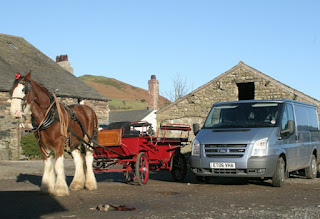
resulted in a visit to the Cumbrian Heavy Horse Riding Centre at Chappels Farm in
the south west corner of the Lake District.
The Centre offers a range of unique horse
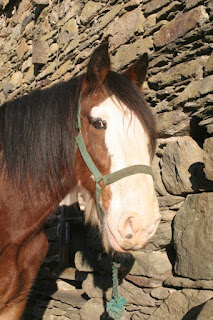
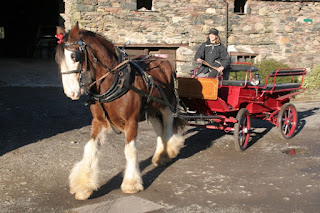
riding and driving experiences. And this was where I was introduced to Max the
Clydesdale. Almost one tonne of muscle, sinew and hair, and yet as docile as a
lamb.
First of all,
there is a major problem with a horse, there is no Handbook in the glovebox. So
you have to learn the Horseway Code before you can start. Fortunately, it’s pretty simple. The words
“OK, walk on” is all that’s required to start it and “Whoa” has the same effect
as putting a foot on the brake pedal. The harder you shout “W-h-o-a” while drawing
out the vowels is similar in effect to stamping harder! As for the emergency
stop, the recommended method is to shout “WHOA” a lot louder while pulling hard
on the reins.
Braking
distances are remarkably impressive given the power output and torque generated
by a huge animal like Max, but an emergency stop on cobbles can produce sparks.
For sure, brakes are needed. At full tilt, a Clydesdale horse (minus cart) can
top 30 mph.
There is no
power steering, but it’s not really needed, a gentle pull either to the right
or left turns the horse. The harder the pull, the tighter the turn. It’s all
about touch and feel – just like a racing car!
Selecting
reverse gear is slightly more difficult. Pulling on the reins while calling
“Back” works, but getting off the cart and walking to the horse’s head and
guiding him back is a better option. As for Parking Brake, the word “Stay” usually
does the trick.
There are no
trafficators either, so when making turns on the road, the driver has to use
hand signals. Neither are there any brake lights!
There is one
serious drawback. There is no key-less entry or inbuilt security system. And
despite your best intentions when parking outside the local shop, any smooth
talking passer-by with a sticky bun or a carrot could tempt the horse to walk
off. Fortunately, Max is not that stupid. And when he realises the stranger has
no more carrots, he will stop and wait for a familiar voice. And there’s no way
on this earth that any mere human could persuade Max to go where he doesn’t
want to go.
Yes, there’s
a lot more to it, but driving a horse and cart is remarkably easy. There are
two working speeds ‘walk’ and ‘trot’ although depending on the rig, some horses
can work up to a ‘canter’, but it’s not about speed, it’s about power.
But there’s
one thing a horse can do that a light commercial vehicle can’t. It will come
when you whistle.
Visiting the
Centre and mixing with the horses proved to be very moving. It was also stimulating
and yet relaxing, and provided a most enjoyable ‘break’ from the pressures of
work. Indeed, for those suffering from stress or gridlock, booking a session
here will do the world of good!
**
Advantages:
No passer-by is ever a stranger when
driving a horse.
You can talk to a horse – and it
will acknowledge you.
Disadvantages:
There is nowhere to plug in the
SatNav.
The driver sits downwind of a huge
animal that eats a lot of roughage!